
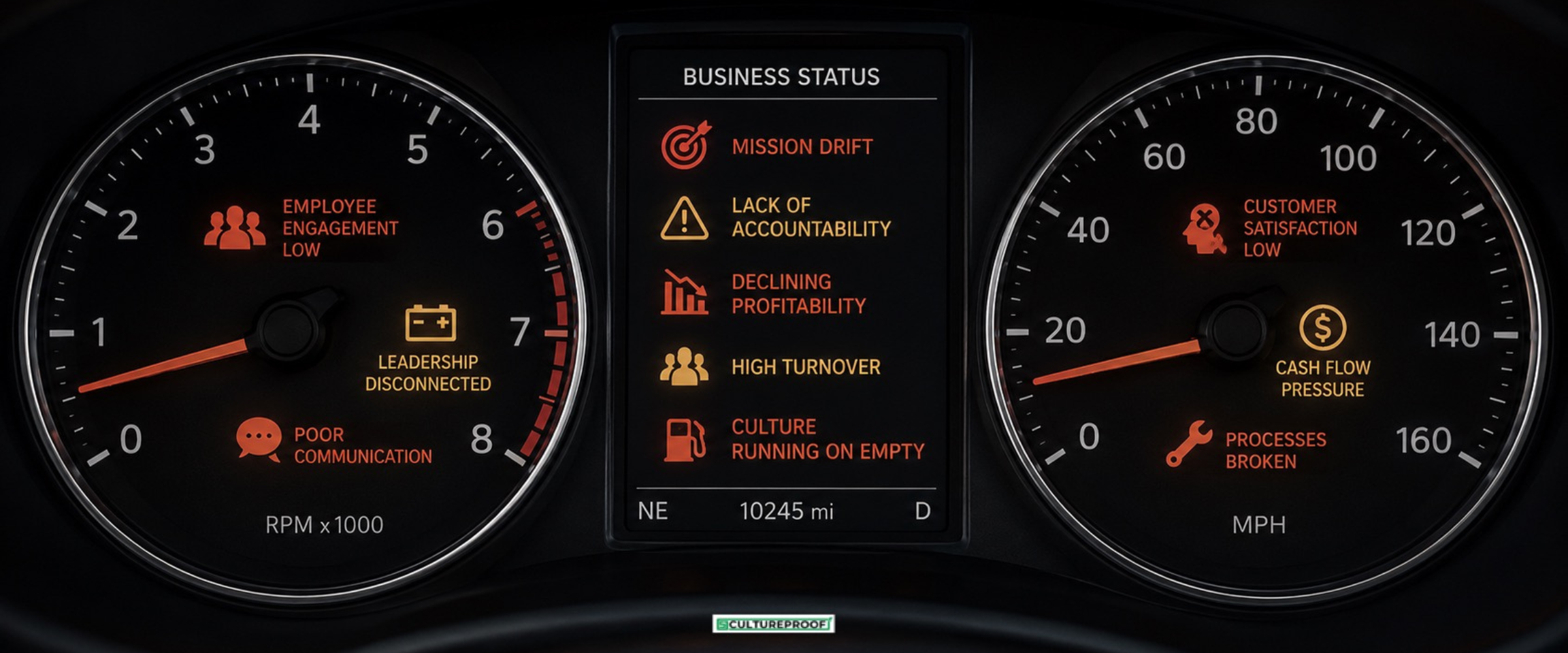
Motion Is Not Momentum. One of the most dangerous places a leader can be is busy.
One of the easiest ways to destroy a perfectly good engine is to ignore the warning signs.
Most of us know this. Yet every day, people continue driving with a low oil light on the dashboard thinking, “I’ll get to it later.” Maybe the engine sounds a little different. Maybe performance is down. Maybe there’s a warning light staring them in the face. But because the vehicle is still moving, they assume everything is fine.
Until one day it ISN’T.
The same thing happens in organizations.
The calendar is quickly approaching the halfway point of the year. Q1 was planning season. Q2 was execution season. You set goals, built budgets, hired people, rolled out initiatives, launched projects, and started chasing outcomes.
Now before you sprint into Q3, this is a great time to check the oil.
Not because something is necessarily broken, but because the organizations that win long-term are the ones that regularly stop and ask a simple question:
“How do we know what we’re doing is actually working?”
Motion Is Not Momentum. One of the most dangerous places a leader can be is busy.
Busy can feel productive. Busy can look super productive. Busy can even sound productive. But activity and progress are not the same thing.
I’ve seen some of our biggest sales months ever while cash flow was quietly getting worse. I’ve had our managers work 70+ hour weeks while our team became more dependent on them than ever. I’ve also seen organizations celebrate growth while profitability, culture, and customer experience were declining.
From the outside, the engine looked perfectly fine.
Inside, it was running dry.
The question is not whether you’re working hard. The question is whether your work is producing the results you actually want.
What Are Your Gauges Telling You?
Every vehicle has gauges. Oil pressure. Engine temperature. Battery voltage. Fuel level.
Imagine driving down the highway and deciding none of them mattered. Sounds ridiculous, right?
Yet that’s exactly how many leaders operate. They lead based on emotion. They lead based on assumptions. They lead based on how they “feel” things are going.
The problem is that feelings make TERRIBLE dashboards.
If you don’t know your numbers, you don’t know your business. If you don’t know your metrics, you don’t know your ministry. If you don’t know your indicators, you don’t know your leadership.
You are simply guessing. And guessing is expensive.
A non-profit may have attendees. A landscape company may have revenue. A sales team may have activity. But if the metric you’re measuring isn’t connected to the mission you’re pursuing, you’re staring at the wrong gauge.
Five Examples of Leadership Oil Gauges
The specific KPI doesn’t matter nearly as much as having one. You need something measurable that tells you whether the engine is healthy.
Whether you run a landscape company, lead a sales team, oversee operations, manage a church, coach a sports team, or simply lead your family, the question is the same:
How do you know what you’re doing is working?
1. Landscape Company
Revenue sounds great. But what if gross margin is shrinking?
You may be selling more work while making less money.
A healthy gauge might be:
- Gross Margin %
- Labor Efficiency
- Production per Labor Hour
Because revenue doesn’t pay the bills. Profit and cash does.
2. Sales Team
Many sales leaders obsess over closed deals. But what if the pipeline is drying up?
Potential gauges:
- New opportunities created
- Proposal volume
- Close rate
- Average sale size
You don’t want to discover three months from now that today’s success is hiding tomorrow’s problem.
3. Operations Team
Everybody is busy. But are customers winning?
Potential gauges:
- Customer retention
- Response time
- Rework/warranty percentage
- Customer satisfaction scores
Being busy fixing problems is not the same as preventing them.
4. Hiring & Culture
Many leaders think everything is fine because nobody is quitting. But what if nobody great is joining either?
Potential gauges:
- Employee retention
- Referral hires
- Open position fill rate
- Employee engagement
A stable team isn’t necessarily a growing team.
5. Personal Leadership
This might be the most important one.
How do you know you’re winning personally?
Potential gauges:
- Time with family
- Physical health
- Quiet time to read and reflect / pray
- Exercise consistency
- Quality conversations with your spouse
- Stress levels
I’ve met plenty of leaders with healthy companies and unhealthy lives.
That’s not success. That’s a trade.
Why Leaders Burn Out
Many leaders don’t burn out because they worked too hard. They burn out because they worked hard without knowing whether it was working.
That’s exhausting.
Nothing drains energy faster than uncertainty. When there are no gauges, every problem feels personal. Every challenge feels permanent. Every setback feels bigger than it actually is.
Metrics don’t remove pressure.
They provide clarity.
And clarity creates confidence.
Stress Test Q2 Before You Enter Q3
This is where most organizations miss the opportunity.
Q2 is almost behind us. You learned things. You made mistakes. You discovered bottlenecks. You found weaknesses. You identified opportunities.
The question is: What are you doing with those lessons?
Before you charge into the second half of the year, stress test the first half. Ask yourself what’s working, what’s not working, what assumptions proved wrong, what you should stop doing, what you should double down on, and what needs to be measured that currently isn’t.
Sometimes the answer isn’t to work harder. Sometimes the answer is to pay attention.
What Does Success Actually Look Like?
Here’s the question EVERY leader reading this should answer this week:
What does success look like for me?
Not for your competitor. Not for social media. Not for your industry.
For you.
For your organization.
For your family.
For your mission.
Then ask the follow-up question that almost nobody asks:
“If I was successful, how would I even know?”
What gauges would move? What metrics would improve? What evidence would exist?
Because if success isn’t measurable, you’ll spend your life chasing a target you can never identify. And if you don’t know what winning looks like, you’ll never know when you’re winning.
So before you race into Q3, take a few minutes and check the oil.
The warning lights are there for a reason. The gauges matter. And the healthiest leaders aren’t the ones who never have problems. They’re the ones who pay attention before the engine blows.
Because engines rarely fail without warning. Leaders usually don’t either.