
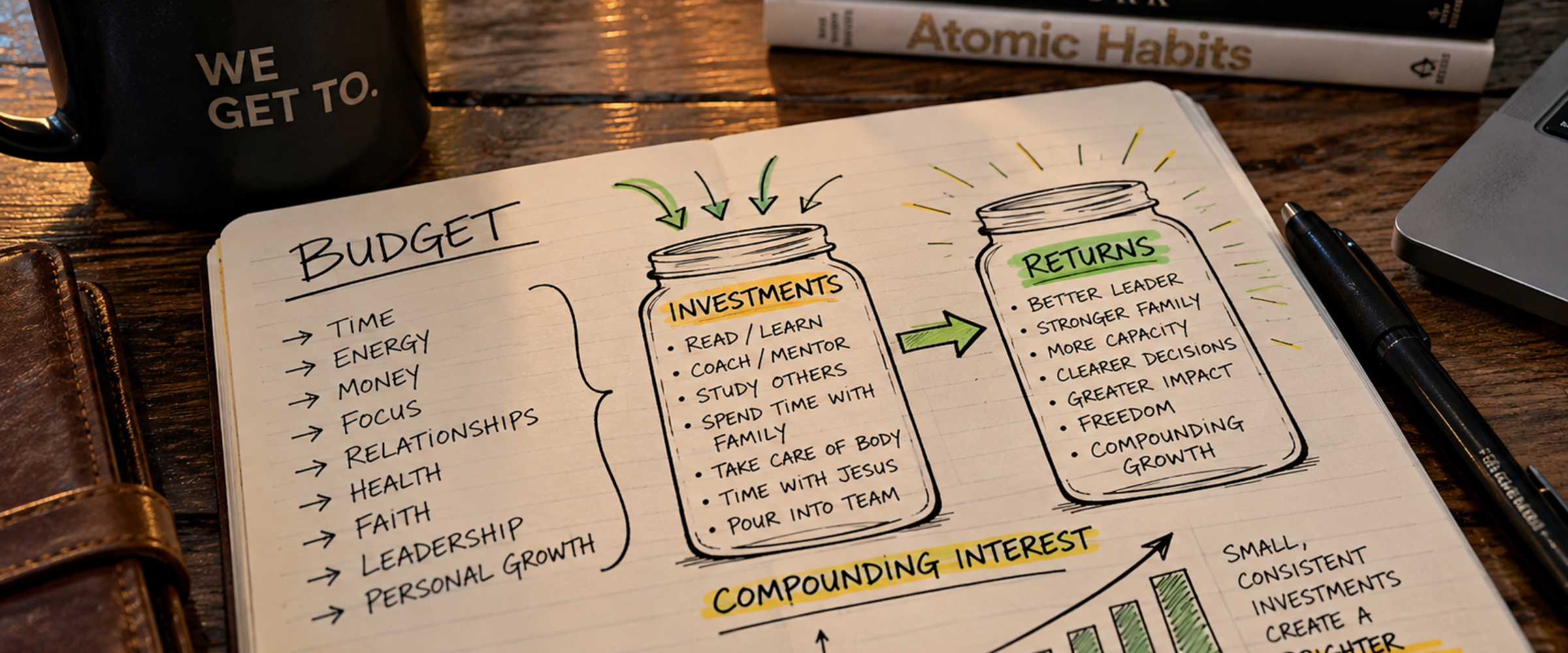
You Can’t Keep Withdrawing From an Account You’ve Never Invested In.
Every business owner understands the importance of a budget.
We know what happens when expenses exceed revenue. We know what happens when we spend more than we bring in. And we certainly know what happens when the bank account runs dry.
But here’s a question I’ve been thinking about lately.
What’s your budget for the things that matter most in your life?
I’m not talking about money. I’m talking about your time, energy, relationships, personal growth, and leadership capacity.
When Brandi and I first started Atlas, our budget was tight. And I’m not just talking financially. That was VERY tight. Every waking hour seemed to be committed to building the business. There were customers to serve, employees to lead, bills to pay, and problems to solve. Like most entrepreneurs, I convinced myself that the sacrifices I was making today would eventually create a better tomorrow.
But looking back, I realize something that hits me pretty hard. The people who got the leftovers of my budget were often the people who deserved the biggest investment. My family.
Think about that for a minute. I was pouring everything I had into building a company that was supposed to create a better life for my family, while sometimes giving that very family whatever time and energy I had left.
And here’s the dangerous part. You can convince yourself you’re doing it all for them while slowly making withdrawals from a relationship you’re not making deposits into.
That’s not just a business owner problem. That’s a leadership problem. I’ve learned that nearly everything meaningful in life operates like a bank account. Your marriage. Your relationship with your kids. Your health. Your faith. Your leadership over your team. Even your ability to think clearly and make good decisions.
Every day, you’re either making deposits or withdrawals. And you cannot continually withdraw from an account you refuse to invest in.
Think about the power of compound interest. If you invest $1,000 and earn 10% annually, after 20 years that original investment grows to roughly $6,727 without adding another dollar. The growth begins creating more growth.
Now imagine applying that same principle to your life.
Thirty minutes reading each morning. An hour with a coach or mentor. Studying leaders who have already walked the road you’re traveling. Intentional time with your spouse. Being fully present with your kids. Taking care of your body. Spending time with God. None of those investments may seem life-changing today. But what happens when you compound them over five, ten, or twenty years?
You become a different leader. A different spouse. A different parent. A different person.
And here’s where I think many of us get it backward. We spend so much time trying to increase the revenue of our businesses that we forget to increase the capacity of the person running them.
We want a bigger business, but we’re operating on an empty personal budget.
Then we wonder why we’re exhausted. Why we’re short with our families. Why our leadership feels stagnant. Why the success we’ve worked so hard to achieve doesn’t feel nearly as fulfilling as we imagined.
Maybe it’s because we’ve been measuring the wrong accounts.
And here’s another thought. When you make investments in yourself, what are you doing with the returns? Are you reinvesting that wisdom into your team? Are you taking what you’ve learned and becoming a better husband, wife, father, mother, or friend? Or are you simply using your increased capacity to take on more work?
Because the goal of personal growth shouldn’t just be to accomplish more.
It should be to become someone who has more to give.
I still love building business. I love goals, solving problems, developing leaders, and seeing what’s possible. But I’m learning that success isn’t just about how much you can build. It’s also about what you’re building into the people who matter most.
Someday, the business will move on without you. The titles will change. Someone else will sit in your chair.
But the investments you’ve made in your family, your faith, your relationships, and the people you’ve led? Those have the potential to keep paying dividends LONG after you’re gone.
So I’ll leave you with two questions.
1) Where are you investing today that you’ll be able to withdraw from tomorrow?
2) And when those investments begin paying dividends, who gets the benefit of your returns?
Because you can build a business with an incredible financial budget and still end up bankrupt in the areas of life that matter most.
Don’t spend your entire life building something successful only to discover you underfunded everything that made it worth building.
We GET TO be intentional about where we invest – Make it count!