
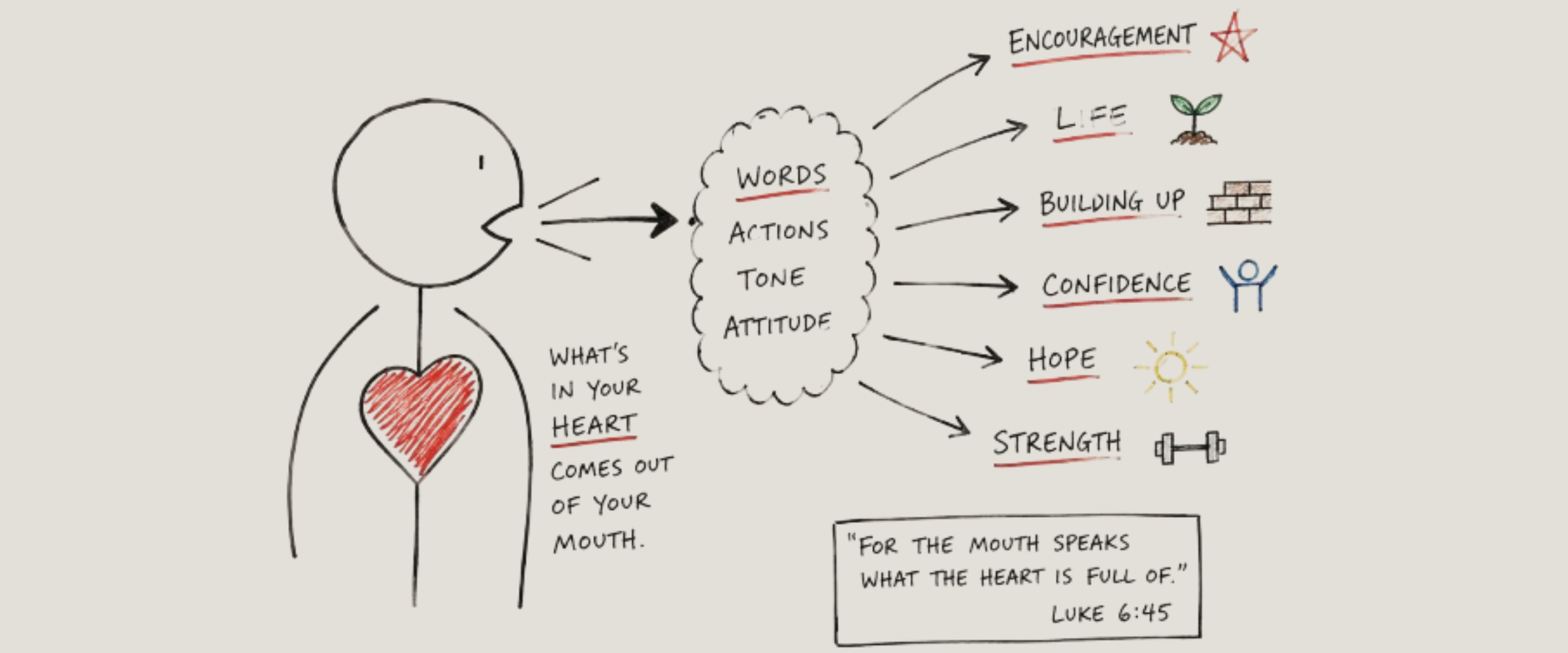
Jesus said it this way: “For the mouth speaks what the heart is full of.” (Luke 6:45)
I’ve been thinking about something lately. A lot.
One of the biggest lies we were ever taught as kids may have sounded harmless, but I think it’s done more damage than we realize.
“Sticks and stones may break my bones, but words will never hurt me.”
Really? I don’t remember every scrape I got on the playground. I don’t remember every bruise, every bump, or every cut. But I remember words.
I bet you do too.
Most of us can still remember something that was spoken over us years, even decades ago. Maybe it was a parent, a coach, a teacher, or your first boss. The conversation lasted a few seconds, but the words stayed for years.
That’s because words don’t just pass through us. They settle inside of us.
They shape the way we see ourselves. They influence the risks we’re willing to take. They affect our confidence, our relationships, and sometimes even the direction of our lives.
Bones heal. Bruises fade. Words have a way of sticking around.
That’s what has me thinking about leadership.
Whether we realize it or not, every one of us is becoming someone’s inner voice.
As a leader or manager, your team hears your voice long after the meeting is over. If you’re a parent, your children carry your words long after they’ve left the house. If you’re a coach, your athletes hear you before every big moment. If you’re a spouse, your husband or wife often hears your voice when they’re questioning themselves.
Our words don’t stop when the conversation ends. They travel home. They ride in the truck. They show up in quiet moments. Eventually, they become part of the story people tell themselves about who they are.
That’s a tremendous responsibility. I’ve also realized something else.
Most communication problems aren’t actually communication problems. They’re heart problems.
Jesus said it this way: “For the mouth speaks what the heart is full of.” (Luke 6:45)
That verse has challenged me. Our mouths aren’t the source. They’re the dashboard.
Think about the dashboard in your truck or in your business. When a warning light comes on, you don’t put a piece of tape over it and pretend the problem disappeared. The light isn’t the issue. It’s revealing the issue.
Our words work the same way. Pressure doesn’t create what’s inside of us. Pressure exposes it.
The words that come out under pressure are often revealing what has been growing inside of us long before the pressure ever arrived.
I’ve learned that where we tend to be the hardest on ourselves is often where we’re hardest on others.
If you constantly tell yourself you’re falling behind, you’ll probably struggle to be patient with someone who’s still learning.
If you never feel like you’re enough, you’ll constantly push others to prove they’re enough. If you beat yourself up every time you make a mistake, don’t be surprised when you struggle to show grace when someone else makes one.
The words we repeatedly speak to ourselves eventually become the words we speak to everyone around us.
That’s why criticism is so often rooted in insecurity. Defensiveness usually isn’t confidence. It’s insecurity trying to protect itself.
Our words are constantly telling on us.
People don’t experience our intentions.
They experience our words.
We’ve all said, “That’s not what I meant.” Maybe not. But that’s exactly what they experienced.
As leaders, parents, spouses, coaches, and mentors, we don’t get to hide behind good intentions if our words consistently leave people feeling discouraged, embarrassed, or diminished.
Now, don’t misunderstand me here. This isn’t about avoiding hard conversations.
Leadership requires accountability. It requires correction. It requires telling people the truth.
But there’s a world of difference between correcting someone and crushing someone.
There’s a difference between saying, “This work doesn’t meet our standard,” and saying, “You always disappoint me.”
One addresses performance. The other attacks identity.
Great leaders learn how to challenge people without making them feel small. They raise the standard while protecting the person’s dignity.
As I was thinking through all of this, one thought kept coming back to me. There is a good chance that somewhere today, someone is having a conversation with themselves using words that originally came from you.
Read that again.
Somewhere today, one of your employees is hearing your encouragement before walking into a difficult meeting.
Or your criticism.
One of your children is trying something new while replaying something you said months ago. Your spouse may be carrying confidence because of words you spoke… or trying to overcome words spoken in frustration.
Your words don’t stop at someone’s ears.
They eventually become part of their inner voice. That’s the weight of leadership.
Maybe it’s time we retire one of the biggest lies we’ve ever taught.
“Sticks and stones may break my bones, but words will never hurt me.”
No.
Sticks and stones can break a bone.
BUT… Bones heal. Bruises fade. But words shape lives.
We are raising the inner voice of the people under our charge – including our own children. Every conversation is planting something. Confidence or insecurity. Courage or fear. Hope or doubt.
If we don’t like what’s coming out, the answer isn’t polishing up the dashboard. It’s looking under the hood.
Train your mind.
Guard your heart.
Choose your words carefully.
Because one day your title will be gone. Your meetings will be forgotten. Someone else will sit in your chair. But your words may still be leading people.
So maybe the lesson isn’t that words never hurt.
Maybe the lesson is this.
Sticks and stones can break a bone.
Words can break a spirit.
Or…
Words can build one. Every day, you get to choose which one your words will do.
The next time you’re frustrated, before you blame the person standing in front of you, pause and listen to the person speaking inside of you. Because the words coming out of your mouth today are often revealing the conversations you’ve been having with yourself for years. Do the work. Heal what needs healing. Guard your heart. Train your mind. The people under your charge deserve a leader whose words don’t just fill the room, but fill people with courage. At the end of the day, your greatest legacy may not be what you built… it may be the people you built with your words.